
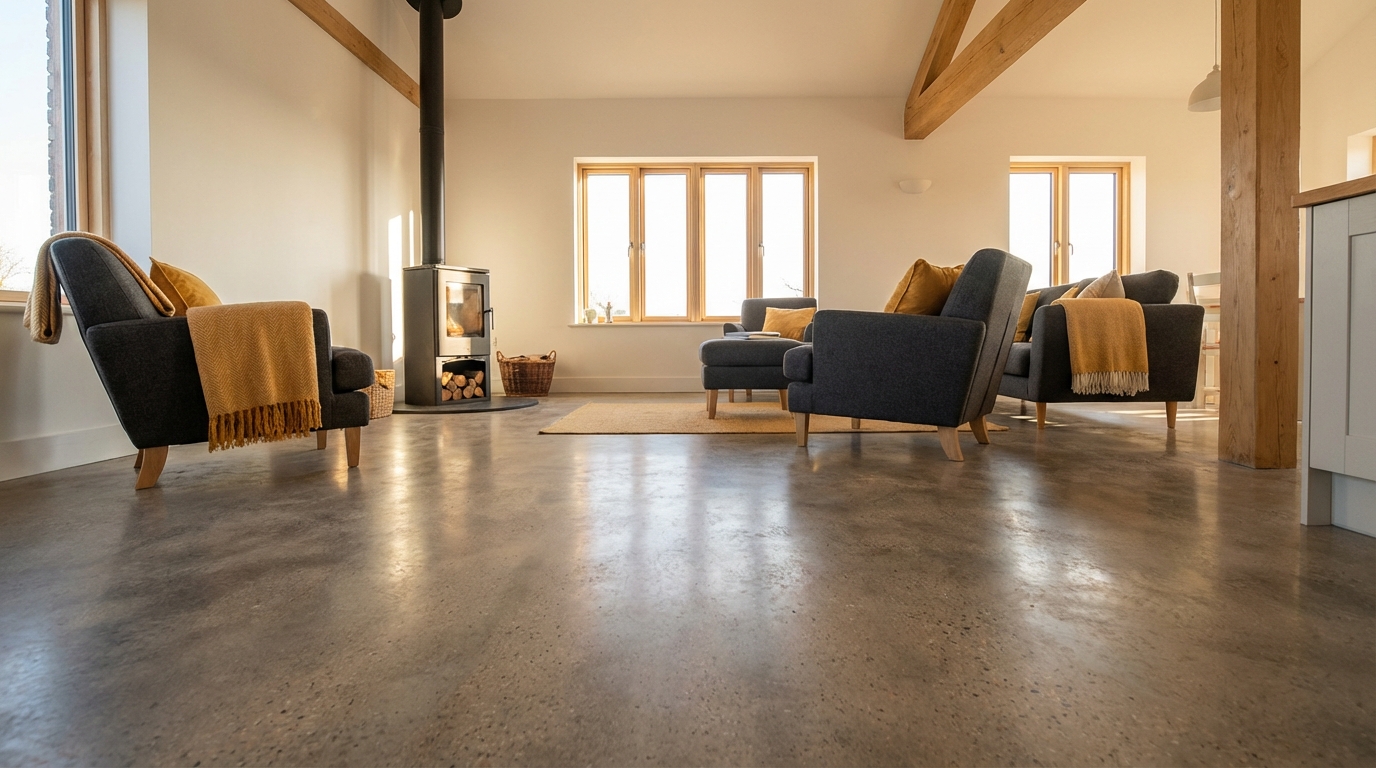
So, you are trying to understand how to use thermal mass in floors for a Passive House design. The short answer is: you can use thermal mass in floors as a stable “battery” for heat, but it only works well if you control solar gain, insulation, and ventilation as a complete system.
In a Passive House, thermal mass in the floor is not the star of the show. Airtightness, insulation, and good windows do most of the work. The floor mass then smooths peaks and valleys in temperature. If you get the design wrong, a heavy floor can feel cold, make the building slow to warm up, and even cause overheating in summer.
- Thermal mass needs predictable solar gain to work well.
- In Passive House, you first cut heat loss, then fine tune with mass.
- Floor buildup, coverings, and insulation placement matter a lot.
- Tiling or exposed concrete works better than thick carpets for heat transfer.
- Too much solar gain on high mass can cause summer overheating.
- PHPP modeling is not optional if you want real performance.
- Think about comfort: warm surface temperature beats raw “mass” alone.
> “More concrete” is not a design strategy. In Passive House, mass helps only when it is part of a clear energy and comfort plan.
What thermal mass in floors actually does in a Passive House
So, what does thermal mass in a floor really give you in a Passive House? Not magic. Just physics that you can either help or hurt.
Thermal mass is the floor’s ability to store heat and release it slowly. You get this from dense materials like concrete, stone, and masonry. In winter, that stored heat can delay temperature swings when the sun stops shining. In summer, if managed right, mass can slow down heat entering the living space.
In a typical leaky house, thermal mass often fails because the heat just escapes through the envelope. In Passive House, the envelope is tight, insulation levels are high, and windows are very high performance. Now, when the sun hits your floor, the heat stays in the building much longer. That is when a concrete or stone floor can actually do useful work.
The main roles of floor thermal mass in Passive House are:
- Reducing temperature swings from solar gain.
- Allowing a smaller, lower power heating system.
- Helping with comfort when you get brief heating outages.
- Shifting some solar gain into the evening.
> Think of the floor as a slow, stubborn radiator that does not turn on and off quickly but keeps things steady.
What Passive House cares about first (before mass)
A lot of owners jump straight to questions about concrete floors, polished slabs, or stone tiles. The technical sequence in Passive House is the opposite of how many projects get discussed on forums.
Here is the real priority list:
- Very good insulation all around the thermal envelope.
- Continuity of insulation at all junctions (no major thermal bridges).
- Very airtight envelope, tested with blower door.
- High performance windows and doors with correct orientation.
- Controlled ventilation with heat recovery.
- Shading for summer: overhangs, blinds, sometimes exterior shutters.
- Then mass and floor build-ups to refine comfort.
If you skip the top of that list and just “pour more concrete,” you do not get a Passive House. You get a slow-responding building that still leaks heat.
> Passive House is about reducing the load first. Thermal mass simply re-arranges when that reduced load shows up.
How thermal mass and Passive House physics interact
1. Low heat loss changes the role of mass
In a standard house, daily heating loads are large. The thermal mass tends to cool off overnight because the building loses so much heat. The next day the sun has to both heat the air and “recharge” the slab. That can feel sluggish and cold underfoot.
In a Passive House, losses are much lower. So:
- The floor cools more slowly overnight.
- Solar gains are more likely to be “too much” than “not enough.”
- Small changes in solar gain or internal loads have more impact.
This means thermal mass is less about “we need extra heat” and more about “we need to slow things down so the space does not heat up too fast.”
2. Surface temperature vs air temperature
Comfort is not only air temperature. Your body cares about the average surface temperatures around you, and floors are a big part of that.
In Passive House:
- Air temperature might be 20 to 22 C.
- Surface temperatures are often within 2 to 3 C of that.
A heated, well-insulated slab with tiles at 21 C can feel comfortable. A cold-feeling concrete floor at 17 C in a regular house does not. So a lot of the “concrete floors are cold” feedback is really about bad envelopes, not the material.
> If the envelope is strong, a massive floor feels “quiet” and stable, not cold.
3. Response time and control
The more mass you have near the surface, the slower your space responds to heating and cooling inputs. That is good for smoothing, but not good if you want fast changes.
For example:
| Floor type | Typical response time | Comfort/control impact |
|---|---|---|
| Light timber floor (thin screed or none) |
Fast (hours or less) | Quick to warm/cool, but more risk of swings |
| Concrete slab with tiles | Medium (several hours) | Stable temperatures, slower adjustments |
| Very thick slab with stone | Slow (half day or more) | Strong smoothing but sluggish for setpoint changes |
With Passive House, you often want “medium.” Enough mass to keep things steady, but not so much that you cannot adjust for an unexpected warm spell or a party with many guests.
Where floor thermal mass actually helps in Passive House
Use case 1: South-facing living zone with solar gain
Imagine a living room with:
- Good south-facing glazing (in the northern hemisphere).
- External shading tuned for summer sun.
- Concrete slab insulated from below.
- Tile or polished concrete finish where the sun lands.
On a sunny winter day, the sun hits the floor. If the floor is:
- Lightweight with carpet: the air heats quickly, then the room gets warm or even stuffy.
- Dense with exposed surface: the slab absorbs some heat, raising surface temp slowly and releasing heat into the evening.
The Passive House envelope keeps that stored heat inside. So you can reduce active heating later in the day.
> In this zone, mass is not about “more heat” but about “better timing” of the free heat you already get.
Use case 2: Mixed use spaces and variable loads
Consider a home office or open-plan kitchen where:
- Internal gains change through the day (people, cooking, equipment).
- You still want a fairly steady temperature.
Some mass in the floor helps:
- Absorb short bursts of heat from cooking or devices.
- Prevent spikes when several people gather.
This pairing works well with a Passive House MVHR system (mechanical ventilation with heat recovery). Fresh air is steady, and the mass damps internal load jumps.
Use case 3: Resilience and outages
Passive House already fares much better in outages than standard buildings. A heavy floor increases that safety margin further.
If the heating system stops for 24 to 48 hours:
- Low heat loss slows down overall cooling.
- Thermal mass slows down temperature drop near the floor.
You still need modeling for your climate, but in many cool climates, this combination keeps temperatures at survivable levels far longer than standard construction.
Where floor thermal mass can backfire
Problem 1: Overheating risk
In Passive House projects, one of the most common comfort issues is summer overheating, not winter cold. Extra mass does not solve this by itself. It can even trap heat.
A heavy solar-exposed floor without:
- Good external shading, and
- Night-time purge ventilation,
will soak up large amounts of heat during the day and then keep releasing it into the evening when you want things cooler.
PHPP (the Passive House Planning Package) includes checks for overheating frequency. If your model already shows high overheating risk, blindly adding more mass to the floor usually does not fix the root cause. You fix solar gain and shading first.
> Mass is not a substitute for shading. If the sun hits it, you still have to deal with that energy.
Problem 2: Sluggish response to heating control
If you install low temperature radiant floor heating inside a very thick slab, and then cover it with a high-mass surface, the control system has a hard time reacting quickly.
Real effect:
- System calls for heat.
- Slab warms slowly over many hours.
- By the time the air warms up, solar gains may arrive.
- Now you have overlapping heat sources and risk overshoot.
Many Passive Houses today use very small, fast systems: radiant ceiling, wall panels, or even simple post-heaters in the ventilation air. If you push all your heat into a very thick floor, you fight against that simplicity.
Problem 3: You “bury” mass under insulation or thick coverings
Not all concrete counts as useful thermal mass. Only the part that is near the inside space and exposed (or almost exposed) is helpful.
You reduce effective mass when you:
- Put the insulation above the concrete instead of below it.
- Cover it with thick carpets and thick underlay across large areas.
- Box it off behind service layers and air gaps.
At that point, you may still pay for the concrete structurally, but you are not getting much benefit from it as thermal mass.
Key design decisions for thermal mass in Passive House floors
1. Slab arrangement and insulation layer position
This is one of the biggest calls: where does the structural slab sit relative to the insulation?
Common setups:
| Type | Description | Thermal mass effect | Passive House comment |
|---|---|---|---|
| “Warm slab” | Insulation under the slab, slab inside envelope | Slab counts as internal mass | Good for solar gains and stable comfort |
| “Cold slab” | Insulation on top of slab, slab partly outside envelope | Slab mass mostly outside thermal zone | Less useful mass, more risk of thermal bridges |
| Suspended slab on insulation | Slab fully supported by insulation or thermal breaks | All slab mass is internal | Strong mass, but careful detailing needed |
For thermal mass, you want the structural slab mostly on the warm side of the insulation. That way the entire thickness of concrete is coupled to the interior.
2. Floor finish materials
Your choice of floor finish either exposes the mass or hides it.
Good “mass-friendly” finishes:
- Ceramic or porcelain tile.
- Polished concrete (with a thin sealer layer).
- Stone tile.
Less “mass-friendly” finishes:
- Thick carpet with underlay (insulates the mass).
- Floating timber floors with insulating foam layers.
- Thick cork or vinyl with high R-value.
You do not need to tile every square meter. Often, you focus on areas that get sun:
- South-facing living areas.
- Winter sun patches along glazing lines.
Rooms like bedrooms can still have softer floors and get less direct gain. You can model how changing finishes in PHPP affects comfort and energy demand.
> Mass that never sees the sun or internal heat does not do much for you.
3. Slab thickness and reinforcement
From a thermal perspective:
- More thickness gives more storage capacity.
- But beyond a certain point, the extra depth is so slow to react that it does little for daily cycles.
Rough guide (talk with your structural engineer for actual numbers):
- 100 mm slab: reasonable mass, quick enough response.
- 150 to 200 mm: plenty of mass for residential Passive House.
- More than 200 mm: added mass may help multi-day swings, but is overkill for daily smoothing in most homes.
In many Passive Houses, the limiting factor is structure, not thermal capacity. You often get “enough” thermal mass with the slab thickness needed for structural reasons.
4. Zoning and room use patterns
You do not need the same level of floor mass everywhere. A smarter approach is to link mass levels to how spaces are used.
Example strategy:
- Living / dining / kitchen with sunlight: high exposed floor mass.
- Bedrooms: lighter floors, focus on acoustic comfort and softness.
- Circulation areas: moderate mass, durable finishes.
PHPP lets you run separate zones or at least do checks on different areas. That way, you can see where mass provides real gain and where it is simply cost and weight.
Working with PHPP when planning floor thermal mass
> A lot of mistakes with thermal mass happen when teams rely on rules of thumb instead of modeling how their specific building behaves.
PHPP is not a dynamic simulator in the same style as full hourly tools, but it does capture:
- Balance of solar gains and losses.
- Frequency of overheating above a set temperature.
- Impact of window area, orientation, and shading.
You use it in a loop:
- Set envelope, insulation, and airtightness.
- Choose preliminary floor buildup and finishes.
- Model solar gains and overheating risk.
- Adjust:
- Window size/orientation.
- Shading strategies.
- Floor finish choices, especially in sunny zones.
- Check impact on heating demand and overheating again.
The mass of internal components is represented in PHPP through internal heat capacity parameters. Many certified Passive House designers have a sense of how different floor build-ups affect perceived “lag” and smoothing, based on past projects plus PHPP runs.
If your project is in a climate with strong seasonal swings or very hot summers, you may complement PHPP with an hourly simulation tool. This becomes more relevant if:
- You are using very large areas of glass.
- You plan heavy floors and walls together.
- Night-time outdoor temperatures stay high.
Thermal mass in floors vs other types of mass
Thermal mass does not have to live only in your floor. You can:
- Expose internal masonry or concrete walls.
- Use dense brick or blockwork inside the insulation line.
- Expose structural concrete columns and beams.
So how does floor mass compare?
| Element | Coupling to solar gains | Impact on comfort | Practical notes |
|---|---|---|---|
| Floor slab | Strong where sun hits it directly | Strong effect on foot-level comfort | Finish choice critical; must be above insulation |
| Internal walls | Moderate; mostly indirect solar gain | Stabilizes air temps, but less effect at feet | Helps with acoustics; affects plan flexibility |
| Ceilings / roof slab | High if sun enters high through clerestories | Stabilizes head-level temps | Needs careful condensation and insulation design |
You often get the best balance if floor mass is paired with some internal wall mass. That way, heat is not all “parked” in one layer.
Floor coverings and real-world comfort
Now, from a practical perspective, people like warm toes. That leads to tension between thermal mass and softness.
You might hear:
> “We love the idea of polished concrete, but we are worried it will feel hard and uninviting.”
Several realistic options solve that:
- Use dense tile in high solar zones and area rugs in seating zones, with care not to cover all sunlit areas.
- Combine tile or polished concrete in circulation areas with engineered wood in bedrooms.
- Use thin rugs with low insulation value over high-mass floors, so you still get some heat transfer.
From an energy point of view, thin rugs are fine, especially if you leave key sunlit areas uncovered. Heavy foam-backed carpets across your main south-facing floor area will weaken your thermal mass strategy.
If radiant floor heating is present, coverings also control how quickly heat reaches your feet. Thicker coverings reduce peak output and slow response, which can be either good or bad depending on your control goals.
Common myths about thermal mass in Passive House floors
Myth 1: “You need heavy floors to meet Passive House standard”
No, you do not. Passive House success comes mostly from insulation, airtightness, windows, and ventilation. Many certified Passive Houses use lightweight timber floors and frame.
Thermal mass can improve comfort and reduce overheating in some climates, but it is not a mandatory ingredient.
Myth 2: “More thermal mass always improves comfort”
Once you go beyond a certain level, extra mass:
- Makes the building slower to adjust.
- Helps less with daily cycles.
- Can lock in unwanted heat longer in warm periods.
You want a balanced design that suits your climate and your lifestyle.
Myth 3: “Carpet kills Passive House performance”
Carpet does not break Passive House performance by itself. What it does is:
- Reduce heat exchange between slab and room.
- Make floors feel different in step temperature.
If your heating demand is already low and your envelope is strong, you can still meet the standard with carpets. You might just lose some of the smoothing effect from the floor in those areas.
Climate-specific strategies for floor thermal mass
Cool to cold climates
In a cool or cold climate, winter performance is the stronger focus. In this case, thermal mass in floors can be very helpful, if solar gain and envelope are well designed.
Key ideas:
- Use south-facing glazing with controlled area and good SHGC (solar heat gain coefficient).
- Place mass in locations that receive winter sun.
- Check that ground insulation below the slab is strong enough to keep slab temps high.
- Watch overheating in shoulder seasons when sun is high but outside temps are still mild.
In climates with cold nights, you can sometimes use night-time ventilation in summer to cool the mass, then let it absorb daytime heat.
Warm or hot climates
In warmer climates, the priority shifts:
- Reducing overheating through shading and window sizing.
- Keeping sun off the floor at the hottest times of day.
- Possibly using night-time cooling if outside temps drop enough.
In some very warm climates where nights stay hot, thermal mass can even be a liability without strong mechanical cooling, because it will store unwanted heat.
So in hot climates:
- Do not assume heavy floors will solve heat problems by default.
- Use PHPP and, if needed, time-step simulations to test different mass levels.
Mixed climates
Many Passive Houses fall in mixed climates where:
- Winters are cool but not extreme.
- Summers have some hot periods but also decent night-time cooling.
Here, floor mass can work very well when:
- Window and shading design is balanced.
- There is a good strategy for purge ventilation at night.
- Occupants understand how and when to open and close shades and windows.
> The best Passive Houses treat mass as one lever among several, not as a single silver bullet.
Coordination with trades and construction reality
Thermal mass in the floor is not just a design idea. It affects:
- Structural design and reinforcement details.
- Insulation type and thickness under the slab.
- Thermal bridge detailing at edges and junctions.
- Floor finish selections and installation methods.
Your Passive House designer, structural engineer, contractor, and floor finisher need to be aligned. A few practical points:
- Agree early that the slab is part of the internal mass and must be fully inside the thermal envelope.
- Detail edge insulation carefully around the perimeter to avoid linear thermal bridges at slab edges and balconies.
- Confirm flatness tolerances if you plan polished concrete or large-format tile.
- Plan for moisture control and curing time so that finishes do not trap moisture in the slab.
If you add underfloor heating, involve the HVAC designer early so that pipe layout, spacing, and depth complement your mass strategy rather than fight against it.
Simple design patterns you can apply
To make this practical, here are a few patterns that often work well. You still need to test them in PHPP, but they give you a starting point.
Pattern 1: Sunny living slab with selective mass
- Ground floor concrete slab, 150 to 180 mm, with insulation beneath.
- Tiles or polished concrete in areas that receive direct sun.
- Bedrooms on upper level with lighter timber floors.
- External shading sized to keep out high summer sun but admit winter sun.
- No or very minimal carpet in main south-facing zones.
Use in: cool and mixed climates where winter solar gain helps.
Pattern 2: Protected mass with strong shading
- Concrete slab with good insulation beneath, throughout ground floor.
- Dense floor finishes in most high-use areas.
- Generous external shading (deep overhangs, louvers, or external blinds).
- Night-time purge ventilation through high-level windows or dedicated vents.
- Limited glazing on east and west to avoid low-angle summer sun.
Use in: mixed climates with risk of summer overheating.
Pattern 3: Hybrid mass-light floor plan
- Massive core: concrete stairwell, internal masonry walls, partial ground floor slab exposed.
- Lighter floors in peripheral rooms (e.g., timber or raised floors).
- Floor mass focused where solar gains and internal loads are highest.
- Careful zoning in PHPP so internal gains and mass are matched.
Use in: projects where structure or budget limits how much slab mass you can expose, but you still want some smoothing.
What to ask your designer or builder about thermal mass in your floor
If you want to make sure your Passive House design uses floor thermal mass in a smart way, ask direct questions:
- “Is our slab inside the thermal envelope, and how is it insulated from the ground and edges?”
- “Which areas of the floor receive winter sun, and what finishes are planned there?”
- “What does PHPP say about overheating frequency before and after we expose more floor mass?”
- “How will shading work in summer to keep the sun off the slab during the hottest parts of the day?”
- “If we add carpets in some rooms, how will that affect comfort and heating control?”
- “If we use underfloor heating, how will pipe spacing and control respond with this mass?”
> If your team cannot show you, in modeling, how the slab affects comfort and overheating, then they are guessing, not designing.
One practical tip to close with: before you lock in your floor finishes, stand in the actual built structure on a sunny day, mark exactly where the sun reaches in winter and summer, and match your high-mass, exposed floor zones to those sun patches rather than just following room labels on the plan. That simple site test often saves you from exposing mass where it never sees the sun, and from carpeting over the most valuable solar collection areas.