So, you are trying to figure out what kind of durable floors make sense for schools and universities. The short answer is: use a mix of polished concrete, high‑performance vinyl, rubber, and carpet tiles in the right zones, and avoid cheap laminates or low‑grade tile that will fail fast.
If you manage or design educational spaces, flooring is one of those boring decisions that quietly eats your budget for the next 10 to 20 years. You do not notice it when it works. You really notice it when you are replacing it in year six instead of year fifteen, or when the hallway looks worn and dirty no matter how much the cleaning crew tries. So your goal is simple: match the floor to the use case, think in life‑cycle cost instead of sticker price, and make cleaning and safety as easy as you can.
Things you need to know:
- One floor type will not work for an entire school or campus; you need zones.
- Upfront price is less important than total cost over 15-20 years.
- Foot traffic, rolling loads, and cleaning methods matter more than color charts.
- Slip resistance, acoustics, and indoor air quality are non‑negotiable in learning spaces.
- Good installation and maintenance plans save far more money than minor material upgrades.
- Concrete, vinyl, rubber, and carpet tiles cover 90 percent of education use cases when chosen well.
Why flooring in education is a long‑term tech decision
When people talk about “technology” in schools, they usually mean tablets, smart boards, and Wi‑Fi. But flooring is a kind of building technology too. It is a material system that has to handle:
- Constant traffic from students, staff, and visitors.
- Rolling carts, lab equipment, and sometimes even robotics rigs.
- Cleaning chemicals and frequent wet mopping.
- Impact from dropped devices, chairs, lab tools, and sports gear.
- Changes in temperature and humidity across the year.
If you think of flooring like tech infrastructure, the logic shifts:
- You care less about fashion trends and more about performance over 10+ years.
- You care about “downtime”: how often areas need to be closed for repairs.
- You care about “maintenance overhead”: how much labor and product go into daily cleaning.
- You care about compatibility with other systems: underfloor wiring, radiant heat, AV layouts.
> Treat your floors like a platform, not a decoration. If the platform is wrong, everything that sits on top of it gets harder and more expensive.
Key performance criteria for school and university floors
Before picking a material, get clear on what “good” means in your context. For education, that usually comes down to eight criteria.
1. Durability under real traffic
A busy hallway in a high school can see thousands of passes a day. A campus corridor that connects lecture halls might handle even more, plus rolling cases, AV carts, food trolleys, and deliveries.
So you need floors that:
- Resist abrasion from foot traffic and grit.
- Handle rolling loads without denting or grooving.
- Survive impact from dropped items.
- Keep their surface integrity even when finish coats wear down.
Look at:
- Wear layer thickness (for vinyl and LVT/LVP).
- Compressive strength (for concrete toppings, underlayments).
- Indentation resistance (for rubber and sports surfaces).
> If the product does not list wear layer thickness or indentation ratings clearly, walk away. You will pay for that lack of data later.
2. Safety and slip resistance
Wet floors in entryways, labs, cafeterias, and restrooms are a real risk. You want surfaces that keep enough grip when wet, without turning into sandpaper that is impossible to clean.
Look for:
- Slip resistance ratings (such as dynamic coefficient of friction numbers).
- Texture that works with your cleaning method; deep texture traps dirt.
- Continuous transitions: avoid sudden changes in height or surface that cause trips.
Many school districts now write minimum slip resistance into their specs for any new flooring or renovation. That is not just for compliance; it is risk management.
3. Acoustics and noise control
Hard floors bounce sound. If you put hard surfaces in long corridors and large classrooms, your background noise rises and speech clarity drops.
That hits learning outcomes. Studies have shown that lower reverberation and better signal‑to‑noise ratio in classrooms improve reading scores and concentration, especially for younger students and for students who have hearing or attention challenges.
This is where material choice matters:
- Carpet tiles and rubber can cut impact noise significantly.
- Vinyl and concrete need acoustic support from ceilings and wall treatments.
- Underlayments can help, but they must match the traffic loads.
> If you fix acoustics only at the ceiling, you are treating the symptom. Floors generate a huge portion of footfall noise in education spaces.
4. Cleanability and maintenance
Floors in schools see:
- Spilled drinks and food.
- Marker stains, paint, glue.
- Dirt tracked in from fields and parking lots.
- Occasional biohazards in restrooms and health offices.
The cleaning crew has limited time and budget each night. So you want surfaces that:
- Clean effectively with neutral cleaners.
- Do not require frequent stripping, waxing, or sealing.
- Do not trap soil in joints or heavy textures.
Think in simple, repeatable processes. If your floor system needs a special product and a special machine for every building, it will not happen consistently.
5. Health and indoor air quality
Students and staff spend long hours in these buildings. Flooring should support healthy indoor air:
- Low VOC emissions, ideally certified by programs like FloorScore or GREENGUARD.
- No added formaldehyde in adhesives or backings.
- Surfaces that do not harbor mold when they get wet.
There has been debate for years about carpet in schools. One side worries about dust and allergens in the pile, the other side points out that modern carpet tiles with regular vacuuming can trap and remove particulates better than hard floors that allow dust to stay airborne. The real answer is in cleaning quality and product selection, not blanket rules.
6. Comfort and ergonomics
Teachers, lab techs, and students stand for long periods. Hard floors like concrete and ceramic can cause fatigue and joint stress, especially over full days.
Materials like rubber, cushioned vinyl, and some carpet tiles give a bit of resilience that reduces fatigue. That matters in:
- Science labs.
- Maker spaces and shops.
- Art rooms.
- Long corridors where staff stand during passing periods.
> If your teachers stand all day on a polished stone corridor, expect more complaints about knees and backs. Floors affect HR, not just facilities.
7. Design, branding, and wayfinding
Campuses are more than boxes with desks. Flooring can:
- Mark zones: quiet study, collaboration, circulation.
- Embed school colors or mascots.
- Guide people to key spaces without heavy signage.
Luxury vinyl tile (LVT), rubber, and carpet tiles all allow patterning without custom manufacturing for every project. Think in terms of “kits”: a few consistent palettes and patterns that your team knows how to install and maintain.
8. Life‑cycle cost, not just purchase price
This is where technology people usually excel: total cost of ownership. Do the same for flooring.
A floor that costs 25 percent more up front, but lasts 10 more years with half the maintenance, is cheaper. You need to model:
- Material cost per square foot.
- Installation labor and prep (including slab leveling or moisture control).
- Cleaning products and labor per year.
- Expected lifespan to replacement.
Here is a simplified comparison for a typical corridor, 10,000 square feet:
| Material | Initial material + install | Estimated lifespan | Annual maintenance cost | 20‑year life‑cycle cost (rough) |
|---|---|---|---|---|
| Low‑end VCT (vinyl composition tile) | $3.50/sf | 10 years | $0.80/sf/year (strip & wax) | ~$3.50 + (0.8 * 20) + replacement at year 10 = high |
| LVT (commercial, 28 mil wear layer) | $6.00/sf | 15-20 years | $0.30/sf/year (no wax) | ~$6.00 + (0.3 * 20) = often lower than VCT |
| Polished concrete | $5.00/sf (grind & polish existing slab) | 20+ years | $0.20/sf/year (auto scrub) | Very competitive, especially in large areas |
The numbers vary by region and building, but the pattern repeats. Cleaning labor kills cheap floors.
Main flooring options for educational spaces
Now let us look at the materials that usually make sense for schools and universities, and where each one fits.
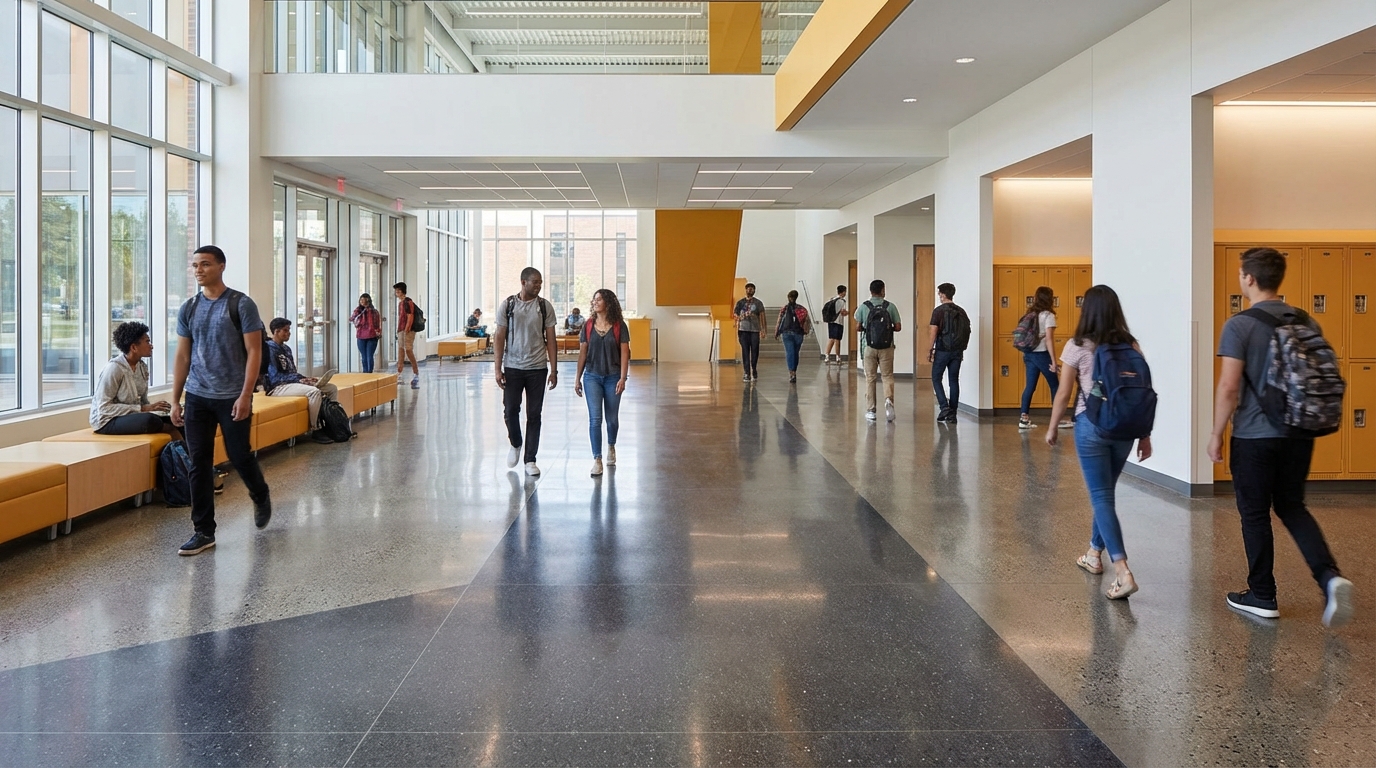
Polished concrete
So, you are wondering if polished concrete is too industrial for education spaces. Short answer: for corridors, lobbies, and some labs, it is one of the most durable, lowest‑maintenance options you can choose.
Polished concrete is not a coating. It is your slab, ground and polished to a smooth surface, often with densifiers and stain guards.
Where it works well
- Main corridors and circulation spines.
- Large atriums and student centers.
- Cafeterias and food courts (with the right slip‑resistant treatments).
- Maker spaces, shops, and some labs.
Pros
- Very durable and resistant to heavy traffic.
- No tiles or seams to fail.
- Low ongoing maintenance; auto scrubbers and periodic re‑polish.
- Can expose aggregate or add stains for visual interest.
Cons
- Hard underfoot; not ideal for long standing without mats.
- Acoustically reflective; can raise noise levels.
- Relies on the quality of the existing slab; cracks and uneven areas may show.
- Cold feel in some climates without radiant heat.
> If your slab is already in and in poor shape, polishing it might not save money. In those cases, a floating system on top can be smarter.
Tips for education projects
- Include slip resistance specs, especially near entrances and food areas.
- Coordinate joint layouts with corridor patterns to avoid random cracking lines.
- Plan power outlets in floors early; coring after polishing is messy and costly.
- Pair with acoustic ceilings and soft furniture in high‑traffic zones.
Resilient flooring: LVT, sheet vinyl, VCT
Resilient flooring covers a range of plastics‑based products. For education, three types come up often:
- Luxury vinyl tile/plank (LVT/LVP).
- Sheet vinyl (homogeneous or heterogeneous).
- Vinyl composition tile (VCT).
Let us break them down.
LVT (Luxury Vinyl Tile)
So, you are comparing LVT to old‑school VCT for your school corridors. The short answer: commercial LVT with a heavy wear layer often wins on life‑cycle cost and looks better longer.
Where it works well
- Corridors and classrooms.
- Offices and meeting rooms.
- Libraries and learning commons (with acoustics support).
Pros
- Wide range of visuals: wood, stone, abstract patterns.
- Individual plank/tile replacement if damaged.
- No regular stripping and waxing for most products.
- Better stain and scratch resistance than cheap sheet goods.
Cons
- More expensive than VCT up front.
- Needs a flat, smooth substrate; prep can add cost.
- Still a hard surface; can be noisy without underlayment.
> Do not pick LVT just by how it looks in the sample board. Ask for abrasion test data and wear layer thickness in mils.
Key spec points for LVT in education
- Wear layer: 20-28 mil or higher for corridors.
- Finish: factory PU or ceramic bead for abrasion resistance.
- Installation: gluedown is usually better for heavy traffic than loose lay or click.
- Scratch and stain resistance: ask for test results, not just marketing claims.
Sheet vinyl
Sheet vinyl comes in rolls and is heat welded at seams. That makes it a strong candidate for spaces that must be hygienic and easy to sanitize.
Where it works well
- Science labs.
- Nurse and health offices.
- Art rooms and wet areas.
- Food prep zones (with the right rating).
Pros
- Fewer seams; can form integral coved base at walls.
- Good resistance to chemicals and stains in the right product lines.
- Can be non‑porous for disinfecting.
Cons
- More skill needed for welding seams and coving.
- Repairs can be more visible if patches are needed.
- Subfloor prep is critical; telegraphing from below is common if prep is rushed.
VCT (Vinyl Composition Tile)
VCT is the classic speckled school tile you see in older buildings. It is cheap to buy. It is not cheap to own.
Where it still shows up
- Districts with very tight capital budgets but large in‑house maintenance capacity.
- Back‑of‑house and storage areas.
Pros
- Low material cost.
- Installers know it well.
Cons
- Requires periodic stripping and waxing.
- Finishes wear fast in high‑traffic zones.
- Looks worn sooner than LVT or polished concrete.
> When you model 15-20 years of waxing and re‑waxing, VCT rarely beats LVT or polished concrete for busy areas.
Rubber flooring
So, you are thinking about rubber flooring for your gym and maybe more. The short answer: rubber is excellent for impact, acoustics, and comfort, and it can work beyond the gym if budgets allow.
Where it works well
- Gyms and multipurpose rooms.
- Weight rooms and fitness centers.
- Stair treads and landings.
- Corridors in special education areas where impact is higher.
Pros
- Great impact absorption.
- Good slip resistance, even when damp.
- Lower impact noise than many other hard floors.
- Comfortable underfoot for long standing.
Cons
- Higher material cost.
- Can show dirt if color choice is poor.
- Some products are sensitive to harsh chemicals; cleaning plans must match.
> For stairs, rubber treads with integrated nosing are often safer and longer lasting than metal nosings over vinyl or stone.
Design and maintenance tips
- Use mid‑tone colors with some pattern to hide wear and soil.
- Avoid very light or very dark colors in heavy traffic stairs.
- Confirm compatibility with your standard cleaning chemicals and machines.
Carpet tiles
So, you are debating if carpet tiles belong in classrooms and libraries. Short answer: yes, in many cases, as long as you choose commercial‑grade tiles and commit to regular vacuuming.
Where they work well
- Classrooms (especially early childhood and elementary).
- Libraries and media centers.
- Study lounges and collaboration spaces.
- Some offices and meeting rooms.
Pros
- Very good acoustic control and sound absorption.
- Improved comfort for sitting on the floor in younger grades.
- Easy replacement of individual tiles when stained or damaged.
- Patterns can help with zoning and wayfinding.
Cons
- Needs regular vacuuming with high‑quality equipment.
- Not ideal for wet areas or entry zones with heavy tracked‑in moisture.
- Cheap tiles can delaminate or show wear quickly.
> Carpet failure is usually not a material problem. It is a maintenance and moisture problem.
Best practices for carpet in schools
- Use entrance systems (mats, grates) to cut down on tracked dirt and moisture.
- Set a vacuuming schedule that matches traffic; daily in busy spaces.
- Plan for spot cleaning and periodic deep extractions.
- Pick modular tiles with solution‑dyed yarn for stain resistance.
Ceramic and porcelain tile
Tile often shows up in restrooms, some entries, and food service areas. Porcelain is more dense and less porous than standard ceramic.
Where it works well
- Restrooms and locker rooms (on floors and walls).
- Commercial kitchens and dish rooms, with specific rated products.
- Entries where snow, ice, or rain is common, with textured tiles.
Pros
- Very durable to surface wear.
- Resistant to water and many chemicals.
- Long service life if installed well.
Cons
- Grout joints can stain and require maintenance.
- Hard and sometimes slippery without the right finish.
- Can crack over substrate movement.
For most educational projects, keep tile focused on wet zones and areas with constant water exposure. For corridors and classrooms, it usually adds cost and noise without enough benefit.
Matching flooring to specific education spaces
Now let us connect materials to real rooms and pathways in a school or campus. Think of your building as a set of use patterns, not just a floor plan.
Entries and vestibules
These spaces take the full impact of outdoor conditions. Snow, rain, mud, salt, sand, you name it.
Goals
- Capture as much dirt and moisture as possible before it spreads.
- Prevent slips in wet weather.
- Protect the floors in the next zone (corridors, lobbies).
Typical solutions
- Recessed entrance mats or grates flush with the floor.
- Porcelain tile with high slip resistance, or textured concrete, in the vestibule.
- Transition to LVT, polished concrete, or rubber in the main lobby.
> Treat your entrance mats as part of the floor system, not loose accessories. Three to five steps on the right mat can remove most grit from shoes.
Main corridors and circulation spines
These are the highways of your building.
Goals
- Survive heavy traffic and rolling loads.
- Stay clean with reasonable effort.
- Support acoustics; do not turn into echo chambers.
Good combinations
- Polished concrete plus acoustic ceiling panels and soft seating in nodes.
- Commercial LVT with a heavy wear layer, possibly with acoustic backing.
- Rubber in special corridors where impact or safety is a concern.
If you use carpet tiles in corridors, pick high‑density, low‑pile products and accept more frequent replacements in certain zones.
Classrooms
Classrooms create their own micro‑environment needs.
Goals
- Keep noise down so speech is clear.
- Stay comfortable for sitting, standing, and moving chairs.
- Handle spills from drinks and classroom activities.
Common strategies
- Carpet tiles in general teaching classrooms, especially for younger students.
- LVT or sheet vinyl in science labs and high spill‑risk rooms.
- Hybrid layouts: resilient near doors and sinks, carpet tiles in the main teaching area.
> Do not let furniture glides be an afterthought. The wrong glides will shred both carpet and resilient floors in a single school year.
Libraries, media centers, and study spaces
These spaces need quiet, comfort, and flexibility for furniture changes.
Goals
- Lower background noise for reading and focused work.
- Support rolling shelving and occasional layout changes.
- Provide a comfortable feel to encourage students to stay.
Good fits
- Carpet tiles over a suitable backing for acoustics.
- LVT in maker corners or cafe zones inside libraries.
Plan for power and data floor boxes early; cutting in many cores later will disrupt floors and be costly.
Science labs and maker spaces
Labs and maker spaces handle chemicals, tools, water, and heavy equipment.
Goals
- Resist spills from chemicals and biological agents.
- Handle impact and rolling loads from equipment.
- Allow easy cleaning and occasional deep sanitation.
Best options
- Sheet vinyl with heat‑welded seams and integral cove, with a chemical‑resistant wear layer.
- High‑performance LVT with good chemical and stain resistance in lighter labs.
- Polished or epoxy‑sealed concrete in heavy maker spaces and shops.
> Coordinate with lab planners on the exact chemicals used. Some solvents attack standard PVC or certain sealers.
Gyms, multipurpose rooms, and athletics
Sports surfaces are their own category, but they live inside your flooring plan.
Goals
- Protect athletes from impact injuries.
- Support competition standards if needed.
- Handle non‑sports events like exams, community meetings, and assemblies.
Options
- Traditional wood sports floors with proper subfloor systems.
- Resilient sports vinyl surfaces for multiuse rooms.
- Recycled rubber for weight rooms and fitness zones.
Make sure you have policies and protection systems (like floor covers) for non‑sports uses that could damage the surface.
Cafeterias and food courts
These spaces mix food, liquids, and high traffic.
Goals
- Handle frequent spills and daily wet cleaning.
- Resist stains from food and drink.
- Stay safe under foot during busy lunch periods.
Common solutions
- LVT in seating areas, with careful selection for stain resistance.
- Sheet vinyl or tile in serving lines.
- Polished concrete in some higher‑education student centers.
> In cafeterias, test stain resistance with the actual products your students buy: juice, ketchup, coffee. Not just lab liquids.
Restrooms and locker rooms
Moisture, cleaning chemicals, and heavy wear in localized zones.
Goals
- Water resistance and easy sanitation.
- Slip resistance in wet and soapy conditions.
- Durable wall bases and transitions to showers or wet areas.
Preferred systems
- Porcelain tile with epoxy grout on floors and walls in many locker rooms.
- Sheet vinyl with coved base in some restrooms.
- Resinous systems in showers and specialty areas, when budgets allow.
Technical details that often get missed
The material choice is only half the story. Execution can make a strong product fail early or outperform its spec.
Moisture in concrete slabs
So, you are wondering why floors bubble or curl a few years after install. Short answer: moisture vapor from the slab was not controlled or measured correctly.
Concrete slabs release moisture as they cure. If you trap that moisture under impermeable flooring before the levels drop, you can get:
- Adhesive failure.
- Mold under some products.
- Dimensional changes in resilient floors.
Key steps:
- Use proper moisture testing (RH probes, not just surface readings).
- Respect the maximum RH levels in the flooring spec.
- Consider vapor mitigation systems if schedules compress curing time.
> Fast‑tracking a project by flooring over wet slabs is one of the costliest “saves” you can make. The repair bill arrives a few years later.
Subfloor prep and leveling
All resilient and tile systems rely on flat, sound substrates. Variations show through, tiles crack, and adhesive bonds can break.
Plan and budget for:
- Self‑leveling underlayments where needed.
- Removal of old adhesives correctly, not just covering and hoping.
- Patch and repair of cracks and control joints based on the flooring type.
Transitions between floor types
Educational buildings have many floor type changes: carpet to vinyl, tile to rubber, concrete to LVT.
Pay attention to:
- Flush transitions with no trip edges in main circulation.
- Appropriate reducers in doorways.
- Expansion and movement between dissimilar materials.
These details affect safety, cleaning (mops catch on bad transitions), and accessibility.
Furniture and floor protection
You can specify the best floor available and then ruin it with the wrong chair glides or desk feet.
Guidelines:
- Use wide, smooth glides that match the surface type.
- Avoid metal feet on resilient and soft surfaces.
- Train staff on moving heavy furniture; use dollies and protection sheets.
> When you change furniture systems, check compatibility with existing floors. Do not introduce a new chair line that cuts little circles into every tile.
Technology layers under and inside the floor
Educational spaces now carry far more wiring and sensors than older buildings. Floors are part of that infrastructure.
Underfloor power and data
In some higher‑education projects, underfloor raceways give flexible power to classrooms and labs. That affects flooring choice.
Consider:
- Access floor systems that accept carpet tile, LVT, or other modular surfaces.
- Panel size and weight for maintenance staff.
- Acoustic and thermal performance of the raised system.
In K-12 buildings, this is less common, but you still have floor boxes. Plan their exact locations so cuts do not slice through critical patterns or cause weak points.
Radiant heating and cooling
Where radiant systems exist in the slab or in panels below, floor choice affects thermal performance.
General rules:
- Concrete and tile conduct heat well.
- Thick rubber and some underlayments can insulate more than you want.
- Check flooring product temperature limits before use on radiant systems.
Sensors and smart building integrations
Some new campuses include occupancy sensors, people counters, or leakage detection under raised floors. While this is still a small share of projects, it is growing.
Coordinate:
- Sensor placement with cleaning and traffic patterns.
- Access points for maintenance under modular floors.
- Data cable routing so it does not conflict with vapor barriers or underlayments.
Creating a repeatable flooring standard for your district or campus
If you manage more than one building, your best move is to build a standard set of flooring “recipes” for each type of space.
Step 1: Map your space types
List the main space categories you have:
- Entry and vestibule.
- Main corridor.
- Classroom, broken down by grade level or teaching type.
- Labs and maker spaces.
- Libraries and media centers.
- Cafeterias.
- Gyms and athletics.
- Offices and admin.
- Restrooms and locker rooms.
Step 2: Choose 1-2 preferred systems per space
For each category, pick a primary option and sometimes a backup. For example:
- Corridors: Primary = Polished concrete; Backup = LVT with 28 mil wear layer.
- Classrooms (K-5): Primary = Carpet tile; Resilient strip near door & sink.
- Science labs: Primary = Heat‑welded sheet vinyl with coved base.
Step 3: Lock in technical minimums
For every product type in your standard, define:
- Minimum wear layer (for LVT).
- Slip resistance requirement.
- Moisture and pH tolerances for adhesives.
- Required certifications for low VOCs.
This keeps value engineering from quietly downgrading performance in each project.
> Write your floor “tech spec” once, and reuse it. Treat deviations like you would deviations from your network security standards.
Step 4: Integrate cleaning protocols into the spec
Every floor choice should come with a cleaning and care plan:
- Daily tasks (sweeping, dust mopping, auto scrubbing, vacuuming).
- Weekly or monthly deep cleaning cycles.
- Products and dilution ratios.
Share this with your custodial team before the project finishes. Ask for their input early; they know which products fight them and which ones work.
Common traps and how to avoid them
To keep this grounded, let us call out mistakes that keep repeating in education projects.
- Picking floors by color board only, with no reference to traffic or maintenance.
- Allowing schedule pressure to override slab moisture control.
- Assuming a maintenance plan exists without actually writing it down.
- Mixing too many floor types, which complicates repairs and cleaning.
- Ignoring acoustics and then trying to fix noise with furniture alone.
- Underestimating the impact of entrances on dirt and moisture throughout the building.
> When budgets get tight, resist the urge to cut entrance systems and acoustic treatments; they protect your investment in the floor itself.
A practical way to start if you are planning flooring now
If you have a project coming up, even a smaller renovation, you can use a simple three‑step approach:
1. Walk your existing buildings with a camera
Spend one day walking current schools or campus buildings and record:
- Where floors are failing or look tired early.
- Where cleaning teams struggle (staining, build‑up, trip hazards).
- Where noise is clearly a problem.
Capture short videos, not just notes. That visual record is more persuasive when you talk to decision makers or design teams.
2. Build a small comparison table for each candidate material
For your next project, narrow flooring options to a short list and compare them on:
| Material | Initial cost | Lifespan | Maintenance | Slip resistance | Acoustics |
|---|---|---|---|---|---|
| Polished concrete | Medium | High | Low | Good with treatment | Poor without acoustic help |
| LVT | Medium‑High | Medium‑High | Low‑Medium | Good (product‑dependent) | Medium |
| Carpet tile | Medium | Medium | Medium (vacuuming) | Good (dry only) | High |
| Rubber | High | High | Low‑Medium | Very good | High |
Keep it simple, one page per building zone, so everyone can see the tradeoffs clearly.
3. Lock in one experiment per project
You do not have to change everything at once. Pick one area in each new project where you upgrade your approach, for example:
- Switch one busy corridor from VCT to polished concrete or LVT with a heavier wear layer.
- Upgrade one set of stairs to rubber treads.
- Try carpet tiles in one library if you have been all hard surface before.
Document how those spaces look and perform over two or three years. Then, roll out what works to the next building.
A simple, practical tip to end on: before signing off on any flooring spec, ask for a written, one‑page maintenance plan from the manufacturer and hand that page to your custodial lead; if they cannot reasonably execute it with current staff and tools, you need a different floor, not a better mop.